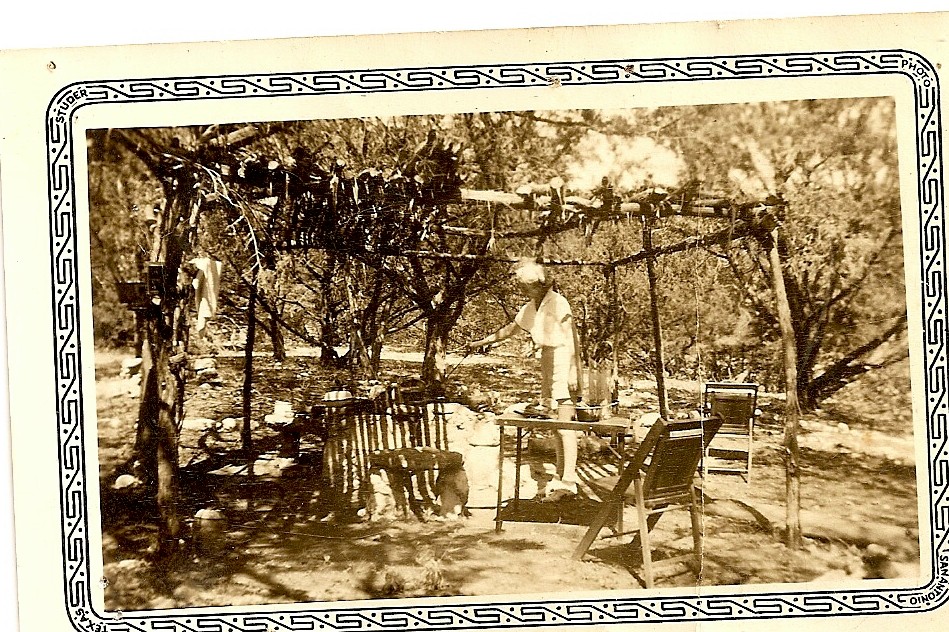
Post copied (non edited) from Gene Blacks writings of Camp 1973
In the year 1899, W.N. and G.W. Hagy, with a Baptist preacher and deacon of the a Baptist church, went on a hunting trip on the east prong of the Frio River at Horse Collar Bend.
They went to Sabinal on the S.P. Railroad and then by wagon to haul their company gear and themselves to their hunting location. They stayed about three weeks. It took two days travel to make the journey. One day across Sabinal prairie to Con Can crossing on the Frio River and after staying htere one night they then reached their camp site on the second day. They found plenty of deer and turkey for their meat meals.
On their return, they reached Rio Frio settlement and stayed one night.
A blue whistle norther blew up and they were able to make the return trip to Sabinal in a covered hearse that a peddler of pans and household goods, was using to cover the ? route in his sales.
Sometime at approximately 1912, the Hagy families started to spend time camping on the Frio River as they had autos by that date. They first camped on the Frio River near Leakey. One of the places was Baptist Flats which is still being used as an encampment ans has many permanent buildings.
The town of Leakey was named for John Leakey who had settled there and cut sycamore lumbar and shingles and sold them to the surrounding territory.
Leakey is the present county seat of Real County. About twelve miles up the West Fork of the Frio River which divides the two forks at Leakey, is the present location of Hagy Camp.
This site was selected by W. N. and G. W. Hagy. This location was owned by Mr. Fred Large, and the location was leased for twenty years at $150.00 per year rental fee, to be used for camping. Mr. Large owned approximately 5,600 acres and he raised cattle and goats. The Large family consisted of Mrs. Large and four children, Maude, Edna, George and Gus.
The first permanent cabin on the present W. N. Hagy site was built by W. N Hagy and Gene Black. It was prefabricated in San Antonio and was erected on a concrete slab. That building was a 12×24 foot structure. Kerosene lamps were used, then Coleman gas lanterns as electrical service was not available. A lazy boy was used to get water from the river as a wire line was installed from the top of the bluff to a rock in the river and a bucket was tied on a pulley and a rope attached to pull the bucket of water up to the top of the bluff. That was easier than climbing the bluff.
Previous to the purchase of Hagy Camp, W. N. Hagy and Frank Scott had enclosed the West side of the hall and screened it and put wooden flaps to keep out the rain. That made the area 20×24 square feet.
Gene built a refrigerator that would hold 100 pounds of ice so that meat and vegetables could be kept under refrigeration. Frank Scott built a rock barbeque pit which was later covered and is still in use at the present date-2017.
In 1946 the land was bought by Jack and Grace Hale. Gene A. Black, bought a total of 7 6/10 acres from the Hales at the total price of $330.00.
It was purchased under an agreement of 1/3 undivided interest by W. N. Eddins, Frank B. Scott and Gene Black, held by the three parties. That agreement of 1/3 undivided interest was not to be changed without consent of all parties concerned for the enjoyment of their children and their children.
W.N. and Stella Eddins built their cabin in 1948.
The third cabin was built by Gene A. and Winifred Black in 1950. It was a 16×16 government building and was used for more slepping quarters.
The REA electric had become available and lighting service was made that allowed the installation of water tanks and electric water pumps.
Hagy Hall was remodeled by Winifred and Gene Black ans Scott Moore. Scott was 16 years of age at that time. That was done in 1958. That allowed us to put in plumbing, kitchen sink, lavatory, toilet with septic tank. A 1,000 gallon water tank was installed with store room underneath the tower.
All the present cabins have refrigeration, air conditioners and electrical appliances. telephone service was installed in 1970.
In 1968, Winifred and Gene Black rebuilt and improved Blacks Kabin installing some windows that had been in the John Frost home on Callaghan Road that W.N. Hagy had built in 1919. That cabin was torn down in 2015.
With addition of store rooms, water tank and pump. hot water heater and a Ben Franklin stove purchased by the Woten family, and many more conveniences, the Black Kabin was a second cabin. Gene built a 10×12 sleeping quarters called Gene’s & Don’s Dog House for more sleeping accommodations.
 A River Runs Through It